Current paper retail
Card Kingdom$0.69
Cardmarket€0.19
ManaPool$0.15
TCGplayer$0.28
Buylist (dealers pay)
Card Kingdom$0.07
MTGO (Cardhoarder)
retail$0.03 tix
90-day paper retail (USD)
3 providers
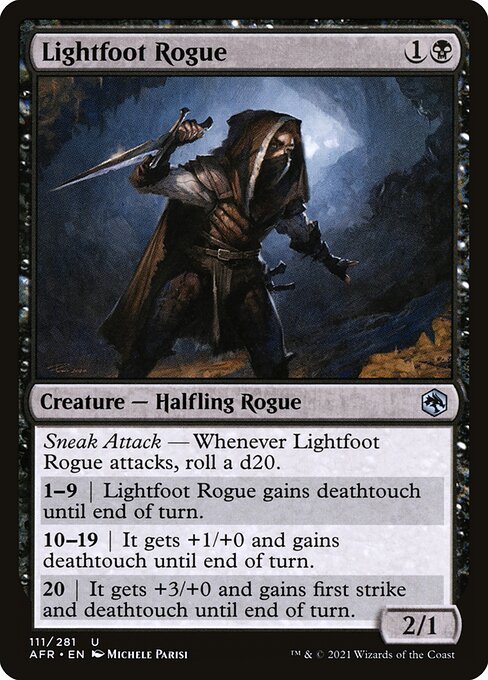
Lightfoot Rogue
UncommonColour IDMV 2
Creature — Halfling Rogue
Sneak Attack — Whenever this creature attacks, roll a d20.
1—9 | This creature gains deathtouch until end of turn.
10—19 | It gets +1/+0 and gains deathtouch until end of turn.
20 | It gets +3/+0 and gains first strike and deathtouch until end of turn.
2 / 1
Card capabilities
Creature
Derived deterministically from card types, Oracle text and keywords. Not a strategic evaluation.
Format legality
Primary formats
Eternal formats
Other printings
This is the only English printing.
Rulings (10)
wotc23 Jul 2021
An ability that tells you to roll a die will also specify what to do with the result of that roll. Most often, this is in the form of a "results table" in the card text.
wotc23 Jul 2021
Dice used must have equally likely outcomes and the roll must be fair. Although physical dice are recommended, digital substitutes are allowed, provided they have the same number of equally likely outcomes as specified in the original roll instruction.
wotc23 Jul 2021
Tournament events have more specific rules regarding dice and die-rolling. For more information, please see the most recent version of the Magic Tournament Rules at https://wpn.wizards.com/en/document/magic-gathering-tournament-rules.
wotc23 Jul 2021
The instruction to roll a die and the effect that occurs because of the result are all part of the same ability. Players do not get the chance to respond to the ability after knowing the result of the roll.
wotc23 Jul 2021
Dice are identified by the number of faces each one has. For example, a d20 is a twenty-sided die.
wotc23 Jul 2021
Some effects may modify the result of a die roll. This may be part of the instruction to roll a die or it may come from other cards. Anything that references the "result" of a die roll is looking for the result after these modifications. Anything that is looking for the "natural result" is looking for the number shown on the face of the die before these modifications.
Similar cardsOpen Card Finder →
Ranked by shared capabilities, colour identity, mana value and type — never by strategic judgement.